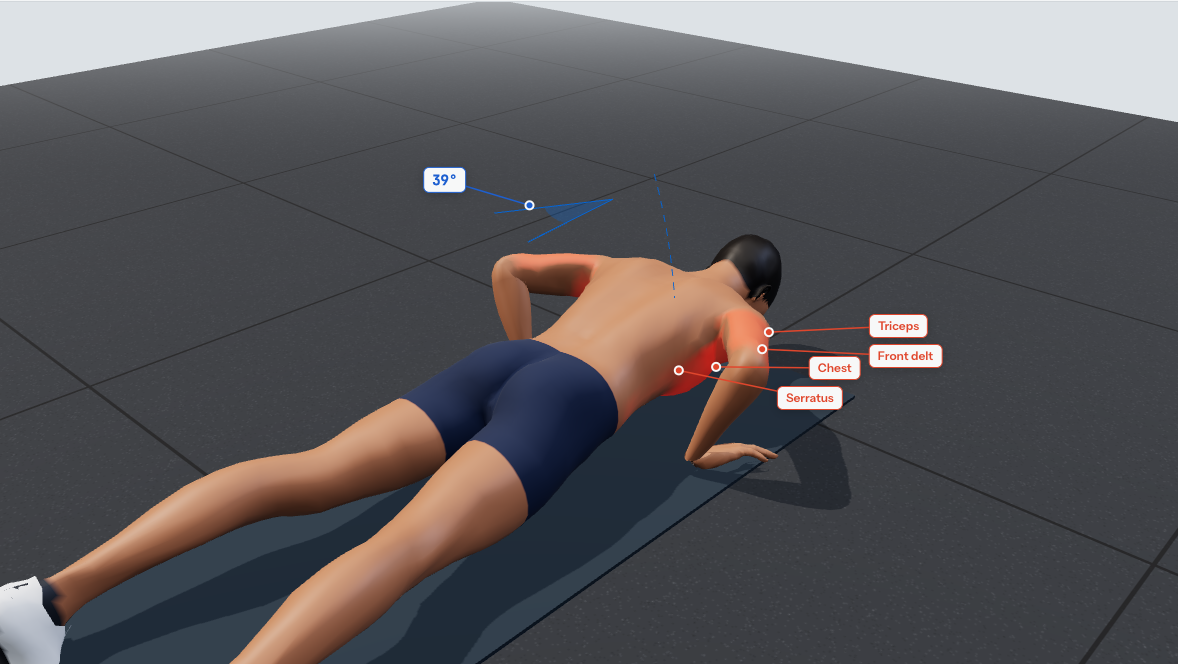
A standard push-up supports about 69% of your body mass at the top and 75% at the bottom [1]. That is a real training load, and two training studies found that push-ups matched to a bench press load built similar strength and chest thickness [2, 3]. Unlike the bench presses in the flat chest press family, your shoulder blades are free to move around your rib cage, which brings in serratus anterior.
How to do a push-up
- Set your hands. Place your hands slightly wider than your shoulders, in line with your lower chest.
- Make a plank. Step your feet back so your body is a straight line from head to heels; squeeze your glutes and brace your stomach.
- Lower as one piece. Bend your elbows to about 45° from your body and lower your chest toward the floor in about 2 seconds.
- Pause near the floor. Stop with your chest about a fist’s height from the floor, or touching lightly.
- Push the floor away. Breathe out and press back up, keeping your hips in line with your shoulders.
- Finish with a small plus. At the top, push a little further so your shoulder blades spread apart.
Fingers point forward or slightly out, feet together or hip-width apart (wider is more stable), and your head stays neutral with your gaze on the floor slightly ahead of your hands. As you lower, your shoulder blades come together slightly; as you press, they spread apart. Finishing each rep with that spread, the “push-up plus”, emphasises serratus anterior relative to the upper trapezius [4].
The bottom is the hardest point: your elbows are most bent and you are holding the largest share of your body mass [1].
Breathing and tempo
Breathe in as you lower and out as you press.
- Demo tempo
- 2-1-1-1
- lowering
- 2 s · inhale
- pause at the bottom
- 1 s · hold
- pressing
- 1 s · exhale
- pause at the top
- 1 s · hold
Slow lowering (2–3 seconds) and pauses at the bottom make push-ups harder without any equipment, which helps once you can already do many reps.
Common mistakes
| Mistake | Why it matters | Fix |
|---|---|---|
| Don't: Hips saggingShown in demo | Your lower back drops into extension because your core isn’t holding the plank. | Squeeze your glutes and brace. Switch to an incline push-up if you need to. |
| Don't: Hips piked up | Shortens the range and shifts load away from your chest. | Keep a straight line from head to heels. |
| Don't: Elbows flared to about 90°Shown in demo | Wide, flared positions load the front of the shoulder more; in bench pressing they raised modelled shoulder loads [6]. | Keep your elbows about 30–60° from your body. |
| Don't: Head dropping or craning | Strains your neck, and often your chest never actually reaches depth. | Keep your neck neutral and let your chest lead. |
| Don't: Half reps | Less training effect per rep and harder to track progress; full-range bench training built more strength than partial reps [7]. | Use the full range and pick an easier variation instead of shortening the rep. |
| Don't: Hands too far forward | Strains the shoulders and makes the lift awkward. | Hands in line with your lower chest. |
| Don't: Shoulder blades winging at the top | A sign of weak shoulder-blade control. | Finish with a push-up plus and slow your reps [4]. |
| Don't: Wrist pain from bent-back wrists | The floor position bends your wrist to about 90°. | Use push-up handles, your fists, or dumbbells as handles to keep your wrists straight. |
Who it suits
- Almost everyone: beginners, home trainees and travellers.
- Athletes who want high-rep or conditioning work.
- Anyone learning to control their shoulder blades.
- Wrist pain: use handles or your fists.
- Shoulder pain: try an incline version, a narrower hand position and controlled depth, and see a physiotherapist.
- Lower-back pain: use an incline or knee version so you can hold the plank.
- Pregnancy: incline push-ups against a wall or bench are commonly used; follow obstetric guidance [8].
- New to exercise or a higher body mass: start with wall or incline push-ups, which move a smaller share of your body mass [5].
Stop and get checked if you feel sharp pain, numbness or tingling in your arms or hands, or dizziness.
Risks
Push-ups are low-risk overall: there is no external load to drop or get pinned under. The usual problems are wrist irritation from the bent-back wrist position and lower-back discomfort from a sagging plank. We found no injury-rate data specific to push-ups, so we can’t put a number on either.
Sets, reps and progression
| Where you are | Reps | Sets | Rest | Effort | How sure |
|---|---|---|---|---|---|
| Starting out: wall or incline push-up | 8–15 | 2–3 | 60–90 s | 2–3 reps in reserve | Moderate[9, 5] |
| You can do 5–10 floor reps: standard push-up | As many as possible, minus 1–2 | 3–4 | 60–90 s | 1–2 reps in reserve | Moderate[10] |
| You can do 20+: feet-elevated, deficit, weighted vest or band | 6–15 | 3–4 | 90–120 s | 0–2 reps in reserve | Moderate[2, 3, 10] |
| Muscle growth: any version taken close to failure | 6–30 | 2–4 | 60–120 s | 0–2 reps in reserve | Moderate–High[10, 11] |
Reps in reserve means how many more good reps you could have done. For growth, pick a version you can do for roughly 6–30 reps close to failure [10], and count your push-up sets toward your weekly chest total [11]. In one study, push-ups loaded to match about 40% of a bench press maximum gave similar results to the bench press [3].
The progression ladder runs: wall → high incline → low incline → knees (optional) → floor → slow or paused → feet elevated → deficit (hands on handles or blocks) → weighted or band-resisted → archer or single-arm. Elevating your hands reduces the load and elevating your feet increases it [5]; feet-elevated push-ups probably also shift emphasis toward the upper chest and front shoulders, by analogy with incline pressing [12]. In a full-body routine push-ups work as the main press for home training, a finisher on push days, or a warm-up.
Variations
With no equipment, free shoulder blades and a hard-working core, the push-up’s load is set by your body mass and the angle you choose. Getting to heavy loads takes a vest, a band or harder variations. If you have dumbbells, the dumbbell bench press is the natural alternative.
Variations
Alternatives
How sure are we
Each claim on this page carries a certainty level: High, Moderate, Low or Insufficient. How we rate evidence.
| Claim | Certainty | Basis |
|---|---|---|
| A standard push-up supports about 69% (top) to 75% (bottom) of body mass. | Moderate | [1]One study; the numbers come via a secondary source. |
| Raising your hands reduces the load and raising your feet increases it. | Moderate | [5]Conference report. |
| Band-loaded push-ups at matched muscle activity gave similar strength gains to the bench press. | Moderate | [2]5 weeks, trained students. |
| Load-matched push-ups gave similar chest growth and strength to a low-load bench press. | Moderate | [3]18 young men, 8 weeks. |
| The push-up plus (spreading the shoulder blades at the top) emphasises serratus anterior. | Moderate | [4]Study details still to confirm. |
| Growth is similar across rep ranges when sets are taken near failure. | Moderate–High | [10]Pooled across exercises. |
Sources
- Suprak DN, Dawes J, Stephenson MD. The effect of position on the percentage of body mass supported during traditional and modified push-up variants. J Strength Cond Res. 2011;25(2):497–503. PubMed 20179649Finding checked via a secondary source · checked 22 Oct 2026
- Calatayud J, Borreani S, Colado JC, Martin F, Tella V, Andersen LL. Bench press and push-up at comparable levels of muscle activity results in similar strength gains. J Strength Cond Res. 2015;29(1):246–253. doi:10.1519/JSC.0000000000000589Verified · checked 22 Oct 2026
- Kikuchi N, Nakazato K. Low-load bench press and push-up induce similar muscle hypertrophy and strength gain. J Exerc Sci Fit. 2017;15(1):37–42. DOAJ recordVerified · checked 22 Oct 2026
- Ludewig PM, Hoff MS, Osowski EE, Meschke SA, Rundquist PJ. Relative balance of serratus anterior and upper trapezius muscle activity during push-up exercises. Am J Sports Med. 2004;32(2):484–493. PubMed 14977678Verified · checked 22 Oct 2026
- Wurm B, VanderZanden T, Spadavecchia M, Durocher J, Bickham C, Petushek E, Ebben W. Kinetic analysis of several variations of push-ups. ISBS Conference Proceedings Archive. ISBS archiveVerified · checked 22 Oct 2026
- Noteboom L, Belli I, Hoozemans MJM, Seth A, Veeger HEJ, van der Helm FCT. Effects of bench press technique variations on musculoskeletal shoulder loads and potential injury risk. Front Physiol. 2024;15:1393235. doi:10.3389/fphys.2024.1393235Verified · checked 22 Oct 2026
- Martínez-Cava A, Hernández-Belmonte A, Courel-Ibáñez J, Morán-Navarro R, González-Badillo JJ, Pallarés JG. Bench press at full range of motion produces greater neuromuscular adaptations than partial executions after prolonged resistance training. J Strength Cond Res. 2022;36(1):10–15. doi:10.1519/JSC.0000000000003391Verified · checked 22 Oct 2026
- American College of Obstetricians and Gynecologists. Physical activity and exercise during pregnancy and the postpartum period. ACOG Committee Opinion No. 804. Obstet Gynecol. 2020;135(4):e178–e188. SummaryVerified · checked 22 Oct 2026
- Ratamess NA, Alvar BA, Evetoch TK, Housh TJ, Kibler WB, Kraemer WJ, Triplett NT. American College of Sports Medicine position stand. Progression models in resistance training for healthy adults. Med Sci Sports Exerc. 2009;41(3):687–708. doi:10.1249/MSS.0b013e3181915670Verified · checked 22 Oct 2026
- Schoenfeld BJ, Grgic J, Ogborn D, Krieger JW. Strength and hypertrophy adaptations between low- vs. high-load resistance training: a systematic review and meta-analysis. J Strength Cond Res. 2017;31(12):3508–3523. PubMed 28834797Verified · checked 22 Oct 2026
- Schoenfeld BJ, Ogborn D, Krieger JW. Dose-response relationship between weekly resistance training volume and increases in muscle mass: a systematic review and meta-analysis. J Sports Sci. 2017;35(11):1073–1082. Verified · checked 22 Oct 2026
- Rodríguez-Ridao D, Antequera-Vique JA, Martín-Fuentes I, Muyor JM. Effect of five bench inclinations on the electromyographic activity of the pectoralis major, anterior deltoid, and triceps brachii during the bench press exercise. Int J Environ Res Public Health. 2020;17(19):7339. doi:10.3390/ijerph17197339Verified · checked 22 Oct 2026