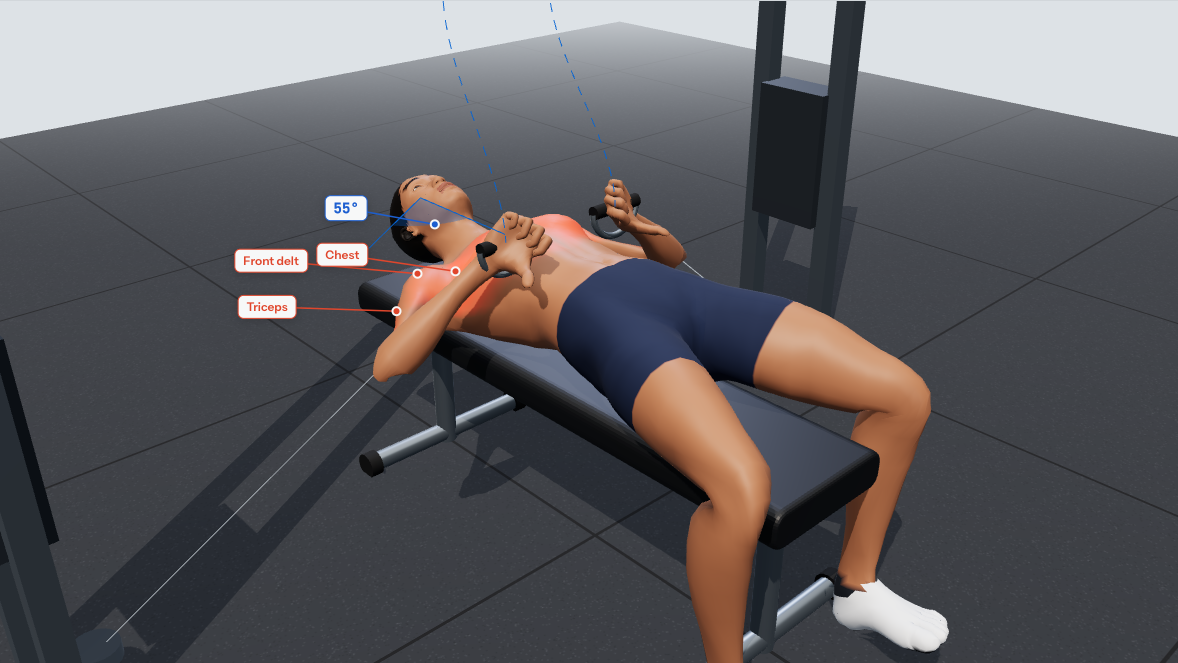
Direct research on the lying cable press is scarce, so most of this page comes from mechanics and from related presses, and it says so where that matters. What the mechanics do tell you is useful. With free weights, gravity pulls straight down, so at lockout the load stacks over your shoulders and the chest gets a rest. A cable pulls along its own line, from the pulley to the handle. With low pulleys beside the bench, that line still points down and outward at the top, so your chest keeps working to hold the handles in. It belongs to the flat chest press family alongside the dumbbell bench press and the barbell bench press.
How to do a cable chest press
- Set the cables low. Put both pulleys at the lowest setting and centre a flat bench between them.
- Take the handles and lie back. Sit, grab a handle in each hand, and lie back with the handles beside your chest.
- Set your base. Feet flat, glutes and upper back on the bench, shoulder blades back and down.
- Press to start. Press the handles up over your chest with your elbows soft.
- Lower with control. Take about 2 seconds to bring the handles beside your chest, elbows about 45–70° from your body.
- Press and squeeze. Breathe out and press up and slightly in; hold the top briefly while the cables still pull outward.
- Finish safely. Bring the handles back to your chest, sit up, and return them to the stacks slowly.
Set-up
- Equipment. A cable station with two adjustable pulleys (a crossover or functional trainer), two D-handles, and a flat bench placed centrally between the stacks.
- Pulley height. Start at the lowest setting, or roughly level with the bench pad. Lower pulleys make the line of pull more vertical, closer to dumbbells; pulleys level with the bench make the top of the movement more like a fly.
- Bench position. Centre it so both cables have the same length and angle, with your shoulders roughly in line with the pulleys or slightly toward your head, so the handles start beside your chest.
- Getting in. Take a handle in each hand while seated, lie back with the handles at chest level, then press to the start. With heavy stacks, a partner can pass you the handles.
Your forearms should sit roughly in line with the cables at the bottom. Set the bench so a full-range rep keeps the weight stack lifted; if the stack touches down between reps, you lose tension and restart with a jerk.
Breathing and tempo
Breathe in as you lower and out as you press. Loads here are usually moderate, so there is little reason to hold your breath. If you have high blood pressure, heart disease or glaucoma, breathe continuously [2].
- Demo tempo
- 2-1-1-1
- lowering
- 2 s · inhale
- pause at the bottom
- 1 s · hold
- pressing
- 1 s · exhale
- pause at the top
- 1 s · hold
The one-second hold at the top makes use of the tension the cables still provide there. That is a practical choice rather than something research has tested.
Common mistakes
| Mistake | Why it matters | Fix |
|---|---|---|
| Don't: Bench off-centre | Uneven cable angles load one side more than the other. | Centre the bench and check both cables look the same from above. |
| Don't: Arms pulled behind the body at the bottomShown in demo | The cables can drag your shoulders too far back into a stretched position. | Stop with the handles beside your chest. |
| Don't: Turning it into a flyShown in demo | Straightening the elbows early shifts load to the shoulder and cuts how much you can lift. | Keep bending and straightening your elbows, like a press. |
| Don't: Stack touching down between reps | Removes tension and makes each rep restart with a jerk. | Move the bench or adjust your range so the stack stays lifted. |
| Don't: Hips lifting or feet sliding | An unstable base. | Plant your feet and keep your glutes down. |
| Don't: Wrists bent back | Strains the wrist. | Handle in the heel of your palm, knuckles up. |
| Don't: Letting go under tension | The handles snap back toward the pulleys. | Return each handle to its stack under control. |
Who it suits
- Beginners: loading is easy to change and the path is guided.
- Lifters who want joint-friendly chest volume.
- People returning after a layoff, once a clinician has cleared them.
- Anyone who wants tension at the top of the press.
Stop and get checked if you feel sharp pain, numbness, tingling or dizziness.
Risks
This is a generally low-risk press: loads are moderate and there is no bar to get pinned under. The specific risks are being pulled into a deep, stretched shoulder position at the bottom, handles snapping back if you let go, and an uneven pull from an off-centre bench. We found no injury data for this exercise, so we can’t tell you how often problems occur.
Sets, reps and progression
| Goal | Reps | Sets | Rest | Effort | How sure |
|---|---|---|---|---|---|
| Learning | 12–15 | 2–3 | 60–90 s | 3–4 reps in reserve | Moderate[4] |
| Muscle growth | 8–20 | 2–4 | 60–120 s | 0–2 reps in reserve | Moderate[5, 6] |
| Muscular endurance | 15–25 | 2–3 | 45–60 s | Stop before form breaks | Moderate[4] |
It is not a primary choice for maximal strength: weight stacks limit the load and it transfers less to a barbell max. Reps in reserve means how many more reps you could have done. For growth, cable sets count toward roughly 10 or more hard chest sets a week [6].
Progress by adding reps within the range, then moving to the next stack increment. If the increments are large, slow the lowering or add a longer top hold before adding weight. In a push/pull/legs split it fits as the second or third chest movement on push day after a free-weight press, or as a joint-friendly main press during a lighter week.
Variations
Compared with its siblings, the cable press keeps tension at the top, takes less load than a barbell, and gives you independent handles like dumbbells but along a guided line of pull. It is very easy to scale but needs a two-pulley station. Options within the exercise: pulley height (low feels like a press, bench height feels like a fly at the top), grip orientation, one arm at a time, and a longer top hold.
A standing cable press is a different exercise: whole-body balance limits it, and in one study the heaviest single-arm standing press was only about a third of body weight, with lower chest activity than a bench press [1]. Lying on a bench removes most of that balance demand, so the lying version behaves more like a bench press. That is a mechanical inference; the study did not test the lying press.
Variations
Harder
How sure are we
Each claim on this page carries a certainty level: High, Moderate, Low or Insufficient. How we rate evidence.
| Claim | Certainty | Basis |
|---|---|---|
| It trains the chest, front shoulder and triceps like the other flat presses. | Moderate | By analogy with the flat chest press family; no direct muscle-activity data for this set-up. |
| It keeps more tension at the top than free weights. | High | Mechanics of the line of pull; the exact profile depends on pulley position. |
| The standing cable press is limited by balance, at about a third of body weight for a one-rep max. | Moderate | [1]Standing and single-arm, not the lying version. |
| Growth depends mainly on effort and weekly volume, not on which press you choose. | Moderate–High | [5, 6]Pooled data across exercises. |
| Training or muscle-activity data for the lying cable press. | Insufficient | We found none; this is a research gap. |
Sources
- Santana JC, Vera-Garcia FJ, McGill SM. A kinetic and electromyographic comparison of the standing cable press and bench press. J Strength Cond Res. 2007;21(4):1271–1279. PDFVerified · checked 22 Oct 2026
- MacDougall JD, Tuxen D, Sale DG, Moroz JR, Sutton JR. Arterial blood pressure response to heavy resistance exercise. J Appl Physiol. 1985;58(3):785–790. PubMed 3980383Verified · checked 22 Oct 2026
- American College of Obstetricians and Gynecologists. Physical activity and exercise during pregnancy and the postpartum period. ACOG Committee Opinion No. 804. Obstet Gynecol. 2020;135(4):e178–e188. SummaryVerified · checked 22 Oct 2026
- Ratamess NA, Alvar BA, Evetoch TK, Housh TJ, Kibler WB, Kraemer WJ, Triplett NT. American College of Sports Medicine position stand. Progression models in resistance training for healthy adults. Med Sci Sports Exerc. 2009;41(3):687–708. doi:10.1249/MSS.0b013e3181915670Verified · checked 22 Oct 2026
- Schoenfeld BJ, Grgic J, Ogborn D, Krieger JW. Strength and hypertrophy adaptations between low- vs. high-load resistance training: a systematic review and meta-analysis. J Strength Cond Res. 2017;31(12):3508–3523. PubMed 28834797Verified · checked 22 Oct 2026
- Schoenfeld BJ, Ogborn D, Krieger JW. Dose-response relationship between weekly resistance training volume and increases in muscle mass: a systematic review and meta-analysis. J Sports Sci. 2017;35(11):1073–1082. Verified · checked 22 Oct 2026