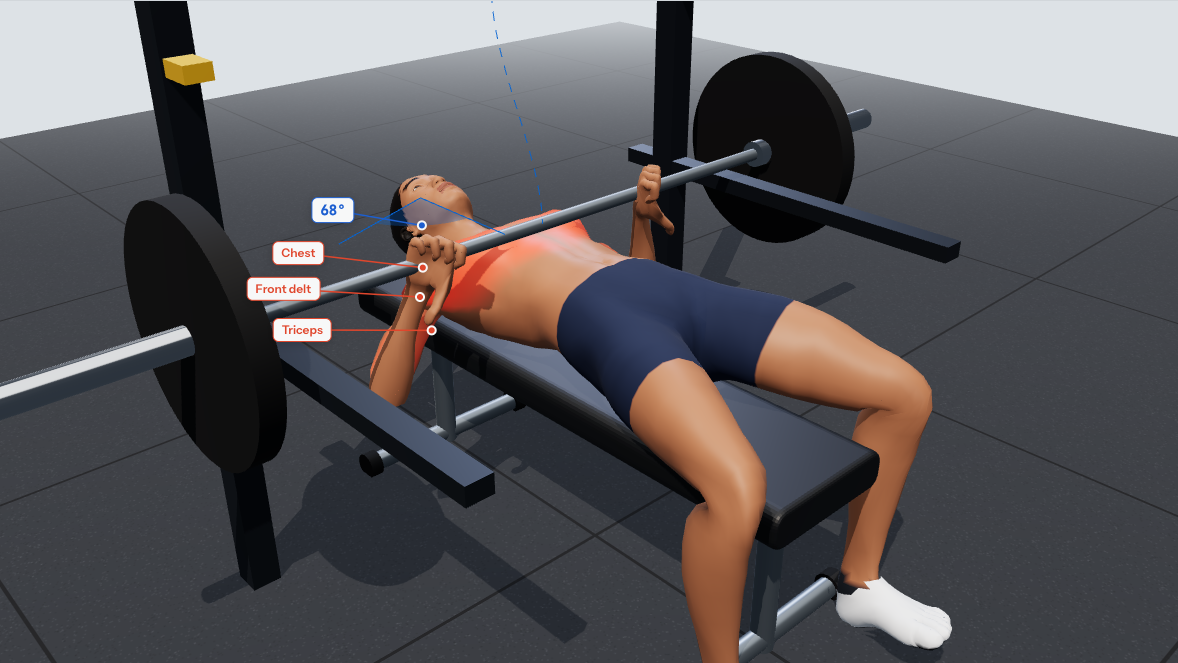
The barbell lets you lift more than the other flat presses: in trained men, dumbbell maximums were about 17% lower [1]. That makes it the lift to build and test pressing strength, and the reason it is the first lift on most push days. It is one of four variations in the flat chest press family; if you are new to pressing, learn the push-up or the dumbbell bench press first.
How to do a barbell bench press
- Set up under the bar. Lie with your eyes under the bar, feet flat, and grip the bar about one and a half shoulder widths apart.
- Lock your shoulders. Pull your shoulder blades back and down and keep your upper back tight against the bench.
- Unrack over your shoulders. Lift the bar out of the hooks with straight arms and bring it over your shoulders.
- Lower to your lower chest. Take about 2 seconds, elbows about 45–70° from your body, forearms vertical.
- Touch and pause. Let the bar touch your chest lightly. No bounce.
- Press back and up. Drive your feet into the floor, keep your glutes down, and press the bar up and slightly back so it finishes over your shoulders.
- Rack it safely. After the last rep, move the bar back until it touches the uprights, then lower it into the hooks.
Set-up details that matter
- Rack and safeties. Set the safety arms or straps just below your chest height with your arch in place. Use a spotter for heavy sets and collars so the plates can’t slide.
- Grip width. About 1.5 times shoulder width is common; check that your forearms are vertical from the front at the bottom. A narrower grip shifts work toward the triceps and away from the mid-chest [2, 3]. In a modelling study, grips narrower than 1.5 times shoulder width lowered compression at the AC joint (where the collarbone meets the shoulder blade), while a grip twice shoulder width raised load on the shoulder joint and the rotator cuff [4].
- Grip. Wrap your thumbs around the bar and set it in the heel of your palm, stacked over your forearm. A thumbless grip lets the bar roll out of your hands.
- Back and feet. Shoulder blades back and down, upper back tight, a natural to moderate arch with your glutes on the bench. Plant your feet where you can push hard without your hips lifting.
Seen from the side, the bar travels down and slightly toward your feet to touch around the lower sternum, then back up and slightly toward your head: a shallow J. The hardest point is usually a few centimetres off the chest, where the bar is furthest in front of your shoulders and your elbows are most bent.
Breathing and tempo
Take a breath and brace before each heavy rep, lower, press, and breathe out near the top. Holding your breath on heavy sets causes large, short-lived rises in blood pressure [6], so if you have high blood pressure, heart disease, glaucoma or recent eye surgery, breathe continuously and get medical advice before heavy pressing.
The demo shows a paused rep, because touch-and-go reps are hard to read:
- Demo tempo
- 2-1-1-1
- lowering
- 2 s · hold
- pause at the bottom
- 1 s · hold
- pressing
- 1 s · exhale
- pause at the top
- 1 s · inhale
For most training, lower under control over 2–3 seconds. Paused reps of 1–2 seconds improve control and remove the bounce.
Common mistakes
| Mistake | Why it matters | Fix |
|---|---|---|
| Don't: Bouncing the bar off your chestShown in demo | Uses rebound instead of muscle, loses control at the most loaded point, and risks your sternum and ribs. | Touch lightly. Pause some sets. |
| Don't: Elbows flared to about 90°Shown in demo | Wide, flared positions raised modelled shoulder loads [4]. | Tuck your elbows to about 45–70°. |
| Don't: A very wide grip (about twice shoulder width) | Raised modelled load on the shoulder joint and rotator cuff [4, 7]. | Grip about 1.5 times shoulder width, or narrower if your shoulders are irritable. |
| Don't: Hips lifting off the benchShown in demo | Less stable, more stress on the lower back, and it breaks competition rules. | Push the floor away through your heels while keeping your glutes down. |
| Don't: Wrists bent back | The bar sits behind your forearm, which strains the wrist and wastes force. | Bar low in the palm, knuckles toward the ceiling. |
| Don't: Bar path over your face or down to your belly | Inefficient and unstable; touching too high adds shoulder stress. | Touch your lower chest; press slightly back toward your face. |
| Don't: Thumbless grip | The bar can roll out of your hands. | Wrap your thumbs around the bar. |
| Don't: No safeties or spotter on heavy sets | A failed rep can pin you under the bar. | Set the safety arms just below chest height. |
Who it suits
- Healthy adults who have learned basic pressing with push-ups or dumbbells.
- Anyone training for strength or powerlifting.
- Lifters who want a simple, measurable way to track progress.
- Shoulder pain, instability or rotator cuff problems: try a narrower grip, a shorter range (a floor press, for example) or dumbbells, and see a physiotherapist [7, 4].
- Pain at the AC joint (top of the shoulder): a narrower grip lowered modelled AC compression [4].
- Wrist pain: check where the bar sits in your hand; wrist wraps may help.
- High blood pressure, heart disease or glaucoma: avoid breath-holding and maximal attempts [6].
- Pregnancy: follow obstetric guidance on lying flat [8].
Stop and get checked if you feel sharp pain in your chest, armpit or shoulder, a pop or tearing sensation, numbness or tingling, or dizziness.
Risks
Wide grips, flared elbows and losing your shoulder-blade position raise modelled loads on the shoulder [4], and clinical guidance for irritable shoulders is to narrow the grip and limit depth [7]. Modelling shows loads, not injuries, so treat these as sensible defaults rather than guarantees. Pain at the top of the shoulder (the AC joint, sometimes called weightlifter’s shoulder) is linked with heavy pressing, and a narrower grip lowered modelled compression there [4].
Sets, reps and progression
| Goal | Reps | Sets | Rest | Effort | How sure |
|---|---|---|---|---|---|
| Learning (after push-up or dumbbell basics) | 8–10 | 2–3 | 2 min | 3–4 reps in reserve | Moderate[9] |
| Strength | 1–6 | 3–5 | 2–5 min | 1–3 reps in reserve; occasional heavy singles | Moderate[9, 10] |
| Muscle growth | 6–12 (wider ranges work) | 2–4 per session | 2–3 min | 0–3 reps in reserve | Moderate–High[10, 11] |
| Power and speed | 3–5 at 30–60% of max | 3–6 | 2–3 min | Fast intent, far from failure | Low–Moderate[9] |
For growth, count your bench sets toward about 10 or more hard chest sets a week across all exercises [11]. Advanced strength work runs at roughly 80–100% of your one-rep max [9].
To progress, add the smallest available load when you hit all your target reps with good form. Beginners can do this almost every session; intermediates usually move to weekly or block progressions and track reps in reserve (how many more reps you could have done) or bar speed to manage fatigue. Lower the bar all the way to your chest: full-range training built more bench strength than partial ranges [12]. In a push/pull/legs split it is the first lift of push day, done one to three times a week depending on the split.
Variations
The barbell has the highest load potential of the family, uses the biceps less as a stabiliser than dumbbells do [1], needs a rack and safeties, and fixes your hand width. Paused reps and a close grip (more triceps) are the usual next steps once the standard lift is solid; an incline bar press shifts emphasis to the upper chest [5]. Those pages are on the way.
Variations
Easier
How sure are we
Each claim on this page carries a certainty level: High, Moderate, Low or Insufficient. How we rate evidence.
| Claim | Certainty | Basis |
|---|---|---|
| The barbell allows the heaviest loads among flat free-weight presses. | Moderate | [1]Trained men, one study. |
| A narrower grip means more triceps and less sternocostal (mid-chest) activity. | Moderate | [2, 3]Muscle activity (EMG) studies with small samples. |
| Wide grips and flared elbows raise modelled shoulder loads; pulling the shoulder blades back reduces several of them. | Low–Moderate | [4]Light load, 10 lifters, computer modelling of loads rather than injuries. |
| Full-range bench training builds more strength than partial-range training. | Moderate | [12]Trained men, 10 weeks. |
| Heavy loads favour maximal strength, while growth is similar across loads when sets go near failure. | Moderate–High | [10]Pooled across exercises. |
Sources
- Saeterbakken AH, van den Tillaar R, Fimland MS. A comparison of muscle activity and 1-RM strength of three chest-press exercises with different stability requirements. J Sports Sci. 2011;29(5):533–538. Cristin recordVerified · checked 22 Oct 2026
- Lehman GJ. The influence of grip width and forearm pronation/supination on upper-body myoelectric activity during the flat bench press. J Strength Cond Res. 2005;19(3):587–591. PubMed 16095407Finding checked via a secondary source · checked 22 Oct 2026
- Barnett C, Kippers V, Turner P. Effects of variations of the bench press exercise on the EMG activity of five shoulder muscles. J Strength Cond Res. 1995;9(4):222–227. Finding checked via a secondary source · checked 22 Oct 2026
- Noteboom L, Belli I, Hoozemans MJM, Seth A, Veeger HEJ, van der Helm FCT. Effects of bench press technique variations on musculoskeletal shoulder loads and potential injury risk. Front Physiol. 2024;15:1393235. doi:10.3389/fphys.2024.1393235Verified · checked 22 Oct 2026
- Rodríguez-Ridao D, Antequera-Vique JA, Martín-Fuentes I, Muyor JM. Effect of five bench inclinations on the electromyographic activity of the pectoralis major, anterior deltoid, and triceps brachii during the bench press exercise. Int J Environ Res Public Health. 2020;17(19):7339. doi:10.3390/ijerph17197339Verified · checked 22 Oct 2026
- MacDougall JD, Tuxen D, Sale DG, Moroz JR, Sutton JR. Arterial blood pressure response to heavy resistance exercise. J Appl Physiol. 1985;58(3):785–790. PubMed 3980383Verified · checked 22 Oct 2026
- Fees M, Decker T, Snyder-Mackler L, Axe MJ. Upper extremity weight-training modifications for the injured athlete: a clinical perspective. Am J Sports Med. 1998;26(5):732–742. PubMed 9784824Verified · checked 22 Oct 2026
- American College of Obstetricians and Gynecologists. Physical activity and exercise during pregnancy and the postpartum period. ACOG Committee Opinion No. 804. Obstet Gynecol. 2020;135(4):e178–e188. SummaryVerified · checked 22 Oct 2026
- Ratamess NA, Alvar BA, Evetoch TK, Housh TJ, Kibler WB, Kraemer WJ, Triplett NT. American College of Sports Medicine position stand. Progression models in resistance training for healthy adults. Med Sci Sports Exerc. 2009;41(3):687–708. doi:10.1249/MSS.0b013e3181915670Verified · checked 22 Oct 2026
- Schoenfeld BJ, Grgic J, Ogborn D, Krieger JW. Strength and hypertrophy adaptations between low- vs. high-load resistance training: a systematic review and meta-analysis. J Strength Cond Res. 2017;31(12):3508–3523. PubMed 28834797Verified · checked 22 Oct 2026
- Schoenfeld BJ, Ogborn D, Krieger JW. Dose-response relationship between weekly resistance training volume and increases in muscle mass: a systematic review and meta-analysis. J Sports Sci. 2017;35(11):1073–1082. Verified · checked 22 Oct 2026
- Martínez-Cava A, Hernández-Belmonte A, Courel-Ibáñez J, Morán-Navarro R, González-Badillo JJ, Pallarés JG. Bench press at full range of motion produces greater neuromuscular adaptations than partial executions after prolonged resistance training. J Strength Cond Res. 2022;36(1):10–15. doi:10.1519/JSC.0000000000003391Verified · checked 22 Oct 2026