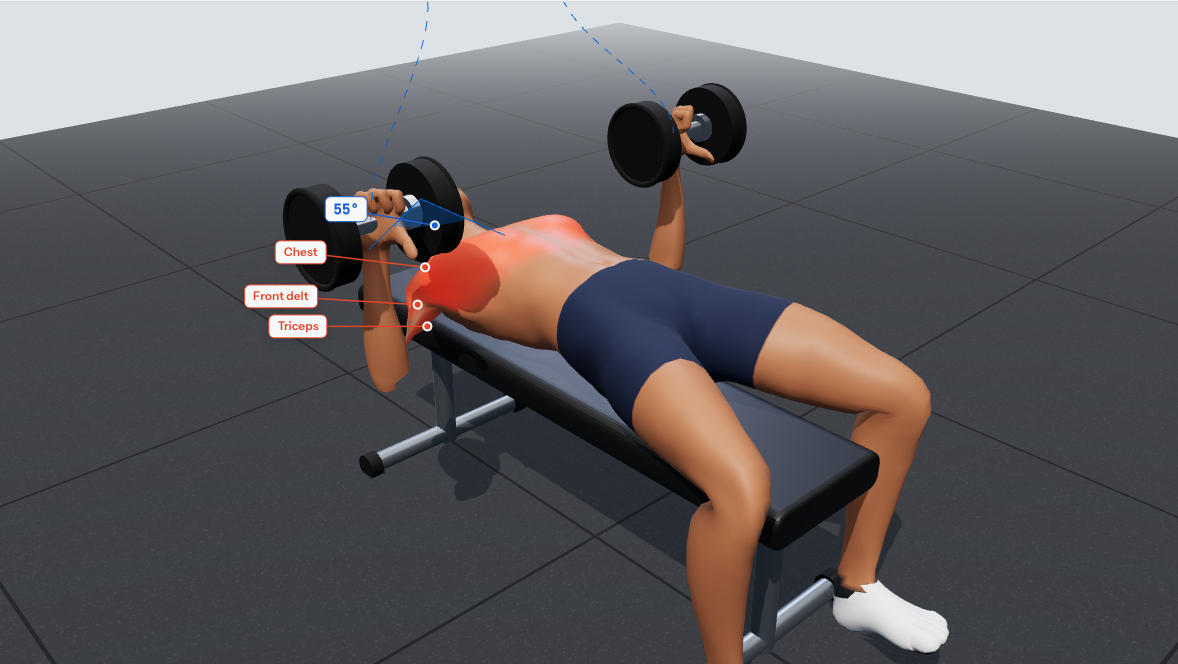
In trained men, the heaviest dumbbell press was about 17% below the barbell bench press, yet measured activity in the chest and front shoulder was similar across the two [1]. That trade, a little less load for a path each arm chooses for itself, is why the dumbbell version is a staple of the flat chest press family. If you want the heaviest pressing, see the barbell bench press; if you have no equipment, start with the push-up.
How to do a dumbbell bench press
- Sit and set. Sit on the end of a flat bench with a dumbbell standing upright on each thigh.
- Lie back with control. Lie back and use your knees to help bring the dumbbells to your chest, then press them up over your shoulders.
- Lock in your base. Feet flat, glutes and upper back on the bench, shoulder blades pulled back and down.
- Lower slowly. Take about 2–3 seconds to bring the dumbbells to the sides of your chest, elbows about 45–70° from your body, forearms vertical.
- Pause briefly. Stay tight for a moment at the bottom. No bounce.
- Press up and slightly in. Breathe out and drive the dumbbells back over your shoulders without clanking them together.
- Finish safely. Bring the dumbbells to your chest, lift your knees, and rock up to sitting with the weights on your thighs.
Hold the handle across the base of your palm, not in your fingers, with your thumb wrapped. That keeps your wrist stacked over your forearm. Palms facing your feet is the default; turning them to face each other (a neutral grip) or halfway (semi-neutral) is a common option if your shoulders prefer it.
The lowest point is where it feels hardest for a reason. Gravity pulls the dumbbells straight down, and the turning load on your shoulder depends on how far your hands sit from the shoulder joint horizontally. At the bottom that distance is largest; at the top the weights stack over the joints and the load on the chest nearly disappears. Go down to chest level or to a comfortable stretch. Dumbbells can go a little lower than a bar, but forcing extra depth adds shoulder stress without a proven benefit.
Breathing and tempo
Breathe in as you lower and out as you press. On heavy sets many lifters hold a breath briefly through the bottom and the start of the press to brace. That causes sharp, short-lived rises in blood pressure [10], so if you have high blood pressure, heart disease, glaucoma or recent eye surgery, keep breathing through every rep and check with your doctor.
Tempo is written as four numbers: lowering, pause at the bottom, pressing, pause at the top, in seconds. The demo uses a slow teaching tempo:
- Demo tempo
- 3-1-1-1
- lowering
- 3 s · inhale
- pause at the bottom
- 1 s · hold
- pressing
- 1 s · exhale
- pause at the top
- 1 s · hold
For normal training sets, a controlled 2–3 second lowering with an intentionally fast press works well. There is no strong evidence that one specific tempo is best for growth as long as your sets are hard.
Common mistakes
Two of these are built into the demo: switch it to a mistake, then to the overhead or side view, to see the difference.
| Mistake | Why it matters | Fix |
|---|---|---|
| Don't: Elbows flared to about 90°Shown in demo | Wide, flared upper-arm positions raised modelled shoulder loads at the bottom of a press [4]. | Keep your upper arm about 45–70° from your torso. |
| Don't: Hips lifting off the benchShown in demo | Shifts load to the lower back, shortens the range and makes you less stable. | Drive through your feet but keep your glutes down. Use a lighter weight. |
| Don't: Dropping fast or bouncing | You lose control in the position where the shoulder is most loaded. | Lower in 2–3 seconds and pause briefly. |
| Don't: Forcing extra depth | Pulls the shoulder forward under load; clinicians often limit depth for irritable shoulders [5]. | Stop at chest level or a comfortable stretch. |
| Don't: Wrists bent back | Loads the wrist, and the dumbbell sits behind the line of your forearm. | Handle across the heel of your palm, knuckles toward the ceiling at the bottom. |
| Don't: Shoulders shrugging or rolling forward | You lose the stable shelf of your shoulder blades and the front of the shoulder takes over. Retraction lowered modelled shoulder loads [4]. | Keep your shoulder blades back and down for the whole set. |
| Don't: Clanking the dumbbells at the top | Removes tension and can destabilise your wrists. | Stop just short of touching. |
| Don't: Dropping the dumbbells out to the sides after the set | A sudden load on the shoulder in a stretched, weak position, and a danger to people nearby. | Bring them back to your chest and sit up. |
Who it suits
- Healthy adults at any level, and especially beginners: it is easy to load lightly and the path feels natural.
- Lifters whose shoulders complain on the barbell bench who still want to press. Try a neutral grip.
- Anyone working on a strength difference between sides, since each arm works alone.
- Current shoulder pain, rotator cuff problems or instability: use a neutral grip, a shorter range and a lighter load, and see a physiotherapist [5].
- A recent chest, shoulder, elbow or wrist injury or surgery: follow your clinician’s return plan.
- High blood pressure, heart disease or glaucoma: avoid breath-holding and very heavy sets, and ask your doctor [10].
- Pregnancy: follow current obstetric guidance and your clinician’s advice about lying flat later in pregnancy; an incline version may be suggested [12].
Stop and get checked if you feel sharp or catching pain, pain that lasts after the set, numbness, tingling or dizziness.
Risks
The shoulder is where most pressing complaints show up. Wide, flared elbows, uncontrolled depth and fatigue are the usual contributors in modelling and clinical guidance [4, 5], though that evidence measures loads and clinical experience rather than injury rates. Dumbbells let your hands rotate and your arms choose their own path, which many lifters find more comfortable.
Elbow and wrist irritation tends to come from bent wrists and bouncing reps, which the fixes above address.
Sets, reps and progression
| Goal | Reps | Sets | Rest | Effort | How sure |
|---|---|---|---|---|---|
| Learning the movement | 10–12 | 2–3 | 90–120 s | Light: 3–4 reps in reserve | Moderate[11] |
| Muscle growth | 6–15 (up to ~30 can work) | 2–4 per session | 90–180 s | 0–3 reps in reserve | Moderate–High[7, 8, 11] |
| Strength | 4–8 | 3–5 | 2–3 min | 1–3 reps in reserve | Moderate[11] |
| Muscular endurance | 15–25 | 2–3 | 45–90 s | Stop before form breaks | Moderate[11] |
Reps in reserve (RIR) means how many more reps you could have done with good form. For growth, about 10 or more hard sets a week for the chest, counted across all your pressing and fly work, is a reasonable target in trained lifters [8]. The barbell is usually the main lift when maximal strength is the goal.
The simplest way to progress is double progression. Pick a rep range such as 8–12. When every set reaches 12 with clean form, move to the next dumbbell size and build back up from 8. Dumbbell jumps are relatively big (2–2.5 kg (about 5 lb) per hand is roughly a 10% jump at moderate weights), so the rep range does the work of bridging the gap. Train through the full range you can control [9].
In a push/pull/legs split it works as the first or second compound on push day; on full-body days, alternate it with the barbell press or push-ups.
Variations
Compared with its siblings, the dumbbell press trades about 17% of maximal load for greater stabiliser work (biceps activity rose with the extra stability demand) and a self-selected path [1]. It is harder to set up when the weights get heavy. Within the exercise you can change the grip (neutral or semi-neutral), press one arm at a time, add pauses, or slow the lowering. An incline version shifts emphasis toward the upper chest [2]; that page is coming with the incline press family.
Variations
Easier
Harder
How sure are we
Each claim on this page carries a certainty level: High, Moderate, Low or Insufficient. How we rate evidence.
| Claim | Certainty | Basis |
|---|---|---|
| Chest, front shoulder and triceps are the main movers. | High | [1, 2, 3] |
| Dumbbell 1RM is lower than barbell 1RM, while chest and front-shoulder activity stay similar. | Moderate | [1]Trained men, one study; muscle activity (EMG) is not growth. |
| Muscles grow across a wide range of reps when sets are taken close to failure. | Moderate–High | [7]Pooled across exercises, not the dumbbell press specifically. |
| More weekly hard sets lead to more growth, in a graded way. | Moderate | [8]The useful upper limit is unclear. |
| Elbows about 45–70° from the torso put less stress on the shoulder than a 90° flare. | Low–Moderate | [4, 5]Modelling at a light load, with a barbell; no injury trials. |
| Training through a full range builds more pressing strength than partial reps. | Moderate | [9]Barbell, trained men. |
Sources
- Saeterbakken AH, van den Tillaar R, Fimland MS. A comparison of muscle activity and 1-RM strength of three chest-press exercises with different stability requirements. J Sports Sci. 2011;29(5):533–538. Cristin recordVerified · checked 22 Oct 2026
- Rodríguez-Ridao D, Antequera-Vique JA, Martín-Fuentes I, Muyor JM. Effect of five bench inclinations on the electromyographic activity of the pectoralis major, anterior deltoid, and triceps brachii during the bench press exercise. Int J Environ Res Public Health. 2020;17(19):7339. doi:10.3390/ijerph17197339Verified · checked 22 Oct 2026
- Barnett C, Kippers V, Turner P. Effects of variations of the bench press exercise on the EMG activity of five shoulder muscles. J Strength Cond Res. 1995;9(4):222–227. Finding checked via a secondary source · checked 22 Oct 2026
- Noteboom L, Belli I, Hoozemans MJM, Seth A, Veeger HEJ, van der Helm FCT. Effects of bench press technique variations on musculoskeletal shoulder loads and potential injury risk. Front Physiol. 2024;15:1393235. doi:10.3389/fphys.2024.1393235Verified · checked 22 Oct 2026
- Fees M, Decker T, Snyder-Mackler L, Axe MJ. Upper extremity weight-training modifications for the injured athlete: a clinical perspective. Am J Sports Med. 1998;26(5):732–742. PubMed 9784824Verified · checked 22 Oct 2026
- Lehman GJ. The influence of grip width and forearm pronation/supination on upper-body myoelectric activity during the flat bench press. J Strength Cond Res. 2005;19(3):587–591. PubMed 16095407Finding checked via a secondary source · checked 22 Oct 2026
- Schoenfeld BJ, Grgic J, Ogborn D, Krieger JW. Strength and hypertrophy adaptations between low- vs. high-load resistance training: a systematic review and meta-analysis. J Strength Cond Res. 2017;31(12):3508–3523. PubMed 28834797Verified · checked 22 Oct 2026
- Schoenfeld BJ, Ogborn D, Krieger JW. Dose-response relationship between weekly resistance training volume and increases in muscle mass: a systematic review and meta-analysis. J Sports Sci. 2017;35(11):1073–1082. Verified · checked 22 Oct 2026
- Martínez-Cava A, Hernández-Belmonte A, Courel-Ibáñez J, Morán-Navarro R, González-Badillo JJ, Pallarés JG. Bench press at full range of motion produces greater neuromuscular adaptations than partial executions after prolonged resistance training. J Strength Cond Res. 2022;36(1):10–15. doi:10.1519/JSC.0000000000003391Verified · checked 22 Oct 2026
- MacDougall JD, Tuxen D, Sale DG, Moroz JR, Sutton JR. Arterial blood pressure response to heavy resistance exercise. J Appl Physiol. 1985;58(3):785–790. PubMed 3980383Verified · checked 22 Oct 2026
- Ratamess NA, Alvar BA, Evetoch TK, Housh TJ, Kibler WB, Kraemer WJ, Triplett NT. American College of Sports Medicine position stand. Progression models in resistance training for healthy adults. Med Sci Sports Exerc. 2009;41(3):687–708. doi:10.1249/MSS.0b013e3181915670Verified · checked 22 Oct 2026
- American College of Obstetricians and Gynecologists. Physical activity and exercise during pregnancy and the postpartum period. ACOG Committee Opinion No. 804. Obstet Gynecol. 2020;135(4):e178–e188. SummaryVerified · checked 22 Oct 2026